
How Many Cigarettes Are in a Carton in Canada?

A Complete Canadian Guide to Carton Sizes, Rules, and History

If you’ve ever wondered how many cigarettes are in a carton in Canada, the short answer is: typically,200 cigarettes. Learn about how Canadian packaging laws, retail practices, and tobacco regulations shape the standard framework for how many cigarettes are in a carton in Canada.


The Canadian Standard: What Defines a Carton?

In Canada, a carton is not legally defined by a fixed number of cigarettes. Instead, it’s defined by how many packs are bundled together.

What is regulated is pack size.

Minimum Pack Size in Canada

Under the Tobacco and Vaping Products Act, cigarettes sold in Canada must be packaged in packs of at least 20 cigarettes. Smaller packs (like 10s) are not permitted.

Because of this, all legal cartons in Canada are built from:

  • 20-cigarette packs, or
  • 25-cigarette packs

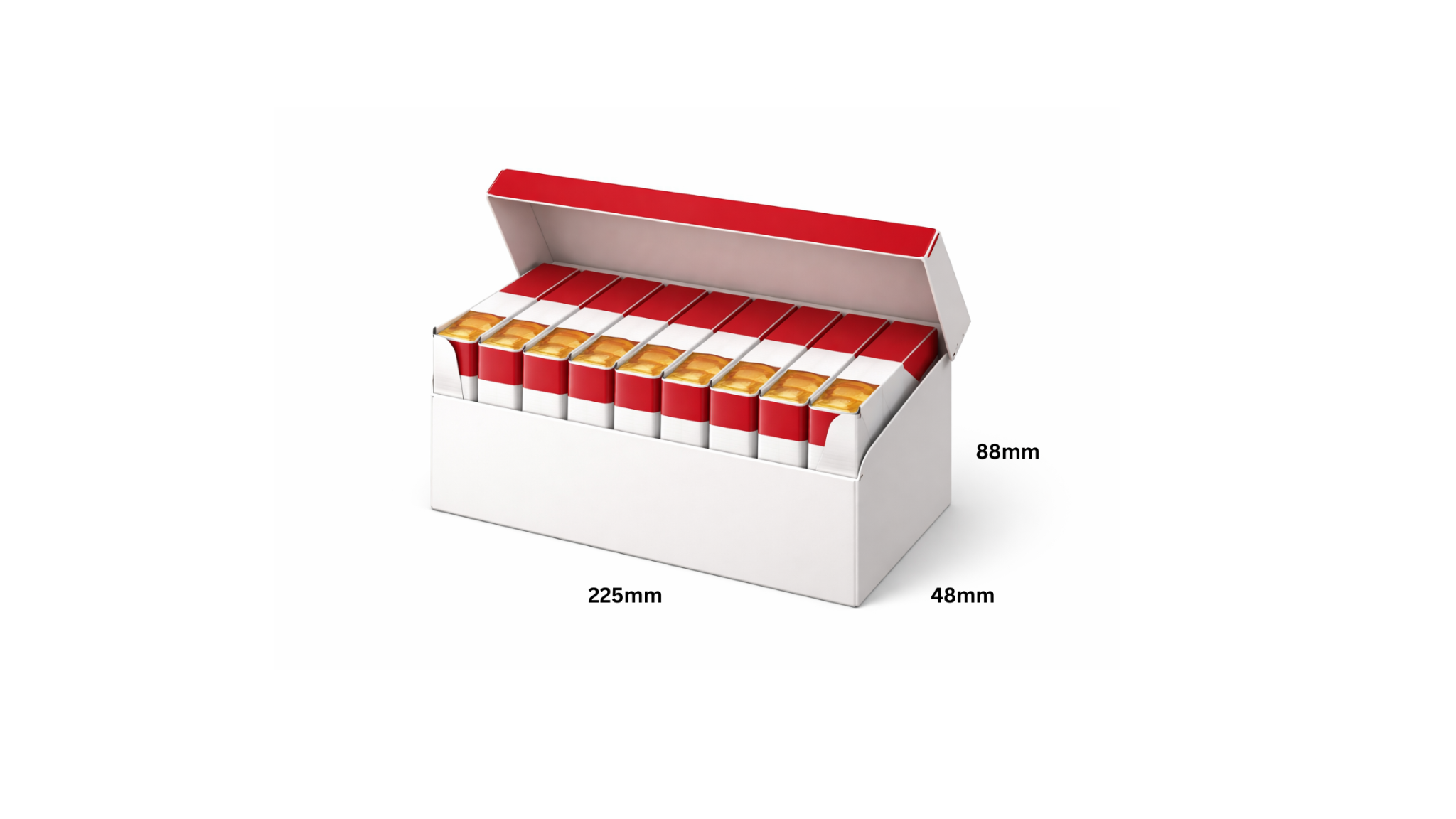
Industry averages have carton sizes being 225mm x 88mm x 48mm. These dimensions almost perfectly accommodate 10 standard packs arranged in rows of five. Packs that contain 25 cigarettes are usually a bit taller, leading to fewer packs in a carton (but you get more cigarettes per pack).

ItemApprox. Size (mm)
Cigarette~84 mm long × ~8 mm diameter
20-pack~85 × 55 × 22
200-cigarette carton~225 × 88 × 48
200-cigarette carton (25s)~225 × 88 × 52
image
How Many Cigarettes Are in a Carton in Canada? 3

Most Common Carton Sizes in Canada

1. The Classic Canadian Carton: 200 Cigarettes

This is the most widely recognized carton format. A carton consists of:

  • 10 packs
  • 20 cigarettes per pack
  • Total: 200 cigarettes

This format is often what people mean when they say “a carton” in Canada and is commonly referenced in travel and customs guidance.


2. Cartons of 25s: 200 Cigarettes

Some Canadian brands and retailers sell cigarettes in packs of 25, which does not affect the number of cigarettes per carton, merely the number of packs that are in a carton.

  • 8 packs
  • 25 cigarettes per pack
  • Total: 200 cigarettes

This format is especially common among certain Canadian brands and value-focused product lines.


3. Bulk Cartons (Less Common)

In some retail contexts (especially bulk or wholesale), you may see:

  • 20 packs per carton
  • Totals of 400–500 cigarettes

These are typically referred to as bulk cartons and are not the everyday consumer standard.


Why Canada Uses These Carton Sizes

1. Regulatory Consistency

Canada enforces strict packaging and labelling laws:

  • Minimum pack size ensures room for health warnings
  • Uniform packaging makes enforcement and taxation easier
  • Prevents low-cost “entry packs” that could appeal to youth

2. Taxation and Excise Control

Cigarettes in Canada are heavily taxed. Cartons:

  • Simplify excise stamp application
  • Make enforcement easier at the retail and distribution level
  • Allow authorities to track volume more efficiently

This is why government references often use 200 cigarettes (one carton) as a benchmark unit.


Carton sizes by country (and why they differ)

Canada

Canada’s laws set a baseline: cigarettes must be sold in packages containing at least 20 cigarettes. From there, what’s “typical” depends on what pack sizes are common in the market. The standard pack is 20 king-size, and there are also regular packs of 25s.

United States

The U.S. market is strongly centred around 20-cigarette packs, and cartons are commonly 10 packs (200 cigarettes).

United Kingdom

In the UK, packs are standardized to at least 20 cigarettes, and modern retail norms generally revolve around 20s—making 200-cigarette cartons common.

Australia (and some other markets)

Australia is an example of a market where pack counts can be more varied (you’ll commonly hear about 25s, but other counts exist), influenced by regulation and market practices. Plain packaging rules also shape how products are presented and standardized.

Why Cartons Exist at All

Cartons weren’t created just for convenience; they serve several practical purposes in Canada’s tobacco supply chain.

Retail Benefits

  • Faster inventory management
  • Easier restocking
  • Simplified pricing for bulk buyers

Consumer Benefits

  • Lower cost per pack
  • Fewer trips to the store
  • Consistent freshness when properly stored

Logistics & Shipping

  • Cartons protect individual packs from damage
  • They stack efficiently in warehouses and transport
  • They act as the bridge between individual packs and wholesale cases

A Brief History of Cigarette Cartons in Canada

Cartons became standard as cigarette consumption rose throughout the 20th century. As smoking became more widespread, retailers needed a bulk format that was:

  • Easy to store
  • Easy to count
  • Easy to sell

Over time, cartons became the default bulk unit, while governments began tying taxation, regulation, and reporting to standardized carton volumes,  especially once health warnings and excise stamps became mandatory.

When Canada later introduced tighter packaging rules, carton structure stayed the same, even as branding changed.


Common Canadian Carton Configurations (Quick Reference)

Pack SizePacks per CartonTotal Cigarettes
20s10 packs200 cigarettes
25s8 packs200 cigarettes
20s (bulk)20 packs400 cigarettes
25s (bulk)16 packs400 cigarettes

How Much are Cartons in Canada? (By Province)

Buying a carton can be a great way to save money rather than buying individual packs. Exact carton prices vary greatly from province to province. This is because each province sets their own provincial taxes on cartons. Below is a chart showing the average price of a carton across all ten provinces and territories:

Provincial Carton Price Overview (Estimated)

ProvinceAvg. Carton Price (200 cigarettes)Price Ranking
Quebec~$90–$110Lowest – most affordable province due to lower provincial taxes.
Alberta~$100–$120Low–Moderate – moderate taxation and no provincial sales tax.
Ontario~$110–$140Moderate – higher retail markup and taxes than QC/AB.
British Columbia~$120–$150+Higher – stronger provincial tax increases.
Manitoba~$130–$150+High – historically one of Canada’s most taxed provinces.
Atlantic Provinces (NS, NB, PEI, NL)~$130–$160+Among the highest in Canada due to strong provincial levies.
Nunavut / Territories~$150–$180+Highest overall — remote logistics + taxes drive prices up. 

FAQs: Cigarette Cartons in Canada

How many packs are in a carton in Canada?

Most cartons contain 10 packs, though some cartons may contain 8 packs.

Is a carton always 200 cigarettes in Canada?

Yes, 200 is the most common number of cigarettes per carton.

Are cartons regulated differently from packs?

Cartons themselves are not tightly regulated, but every pack inside them must comply with Canadian tobacco laws, including labelling and minimum size. Carton is the standard metric when determining allowance at duty-free or international airports.

Why does the government often refer to 200 cigarettes as a carton?

Because 10 packs of 20 is the most common and historically standard format used for taxation, customs, and reporting.

How much is an average carton in Canada?

The final price of a carton in Canada depends on the province you’re in and the retail location you’re buying from. Every province has their own tax and duty scheme, which makes prices vary greatly across provinces. Provinces like BC, Manitoba, Atlantic Provinces, and Nunavut have some of the highest taxes, therefore, prices on cartons. You can find the lowest carton prices in Quebec and Alberta. Carton prices will differ slightly among retail suppliers, depending on the markups they apply.


Final Takeaway

There are several advantages to having a standard number of cigarettes per carton; in Canada, this number is 200 cigarettes. Having this metric makes it easier for governments to tax tobacco products while bringing down the cost per pack for smokers. On the supply level, cartons make sense due to their structure, allowing for ease of storage and transportation. It also makes pricing more consistent across different retail locations. The biggest factor that has an impact on carton prices is provincial taxes, hence, the varying averages across different provincial lines. As a smoker, it’s important to understand why cartons are packaged the way they are and how it may impact your spending and consumption.

Want to save money on cartons? Shop online exclusively from Cigarette Express, and save up to 75% on bestselling native and Canadian cigarette cartons.

Do Cigarettes Expire? Smoker’s Guide to Keeping Tobacco Fresh

Whether you’re a casual smoker or a daily user, you may have wondered: Do cigarettes expire? It’s a fair question. Tobacco is an organic product, subject to moisture loss, aroma degradation, and chemical changes over time. For smokers who enjoy buying in bulk, the real concern becomes: Will my cigarettes go bad, lose flavour, or become harmful if they sit for months or even years?. This guide walks you through the facts, storage tips, shelf‑life expectations, and how to keep your packs fresh as you got them.


Understanding What “Expiry” Means for Cigarettes

Unlike many food items or pharmaceuticals, most commercial cigarette packs do not carry an expiration date. Two years is the typical timeframe during which cigarettes can be stored if they’re in a dry and cool area.

The reason? Cigarettes are treated as durable goods rather than perishable products. According to a scientific review:

“Tobacco is a product with a limited useful life, which loses its original characteristics when the tobacco leaf deteriorates due to changes …” PMC

In practice, cigarettes don’t expire like milk—they age, dry out, or go stale. The result may be a rougher taste, harsher draw, or even higher risk of uneven burn. Even if your cigarettes are technically usable, they may not deliver the experience you expect. Similarly, cigars also don’t have an expiry date but those who’ve had them before know that once you leave a cigar out of the humidor, it tends to crumble quickly and the flavor completely goes off. Cigarettes are more forgiving in comparison to cigars, because they’re not wrapped in delicate tobacco leaf. However, they can still go stale after a long time, or if they’re not stored properly.


How Long Do Cigarettes Last?

Determining how long a pack of cigarettes lasts depends on several variables: storage conditions, whether the pack is opened, humidity, temperature, and exposure. 

Unopened Packs

If the pack is still sealed and stored properly, the cigarettes should be good for 1-2 years. Cigarettes are protected from moisture loss through two layers: the foil that protects the cigarettes, and the box that’s usually lined with cellophane. In most countries, it’s de facto not to have an expiry date on cigarettes. In fact, the German Cigarettes Association claim cigarettes can be good to smoke if “left unopened for decades”. So while “forever” may be a stretch, two years is a reasonable threshold for unopened products under good conditions.

Opened Packs

Once you break the seal, the clock ticks much faster. Moisture escapes, the foil seal is broken, and the tobacco is exposed to air and humidity. Realistically, opened packs should ideally be consumed within 6 months, and many smokers report noticeable degradation even after weeks or months.


What Happens When Cigarettes Degrade?

image
Do Cigarettes Expire? Smoker’s Guide to Keeping Tobacco Fresh 8

It’s easy to tell when milk’s gone bad; you give it a good whiff. But how can you tell whether cigarettes are expired if they don’t have an expiry date? Here’s how you know your cigarettes might be past their due date:

Key factors include:

  • Drying of the tobacco: Moisture is a key component of tobacco flavour and smooth burn. A dry cigarette may burn faster, taste harsher, and feel rougher on the throat. Indications of dry tobacco are yellowing of the paper and cracks.
  • Oxidation and loss of aroma: Over time, flavor compounds in the tobacco oxidize or evaporate, leaving dull aroma and less flavor.
  • Moisture or mould risk: High humidity or poor storage can cause mold or fungal growth inside a pack.
  • Uneven burn or filter issues: As wrapper moisture changes, burn rate and draw resistance can shift. Capsule‑style cigarettes (with flavour capsules) are especially sensitive

In short, the quality may degrade without necessarily creating new health risks (though smoking remains harmful regardless). The primary issue is the negative impact on the experience.


Characteristics of Tobacco: Does it Expire?

image 1
Do Cigarettes Expire? Smoker’s Guide to Keeping Tobacco Fresh 9

Tobacco is the main ingredient in cigarettes, and like any organic plant material, it can degrade over time. As tobacco ages, natural processes like fermentation and oxidation continue—even after harvesting and packaging. This gradual change affects the moisture content, aroma, and flavor of the cigarette.

One of the key factors behind this transformation is fermentation. It occurs more intensely in black tobacco (commonly used in stronger or European-style cigarettes) than in blond tobacco (which is lighter and more common in North America). While fermentation is essential during curing to enhance flavor and reduce harshness, it doesn’t completely stop after the product is sealed.

Because of this, tobacco inside a cigarette pack continues to evolve. When stored properly, the changes are slow and relatively subtle. But if the cigarettes are exposed to humidity or temperature fluctuations, the aging process speeds up, leading to a stale, dry, or unpleasant smoking experience.

The good news? Old cigarettes don’t “expire” in the way food or medicine does—they’re not likely to become dangerous. But they can become harsh, bitter, or lose their aroma entirely. As a smoker, you’ll probably notice the difference in taste, draw, and overall satisfaction long before the tobacco poses any real health risk.

How to Store Cigarettes to Keep Them Fresh

If you’re going to keep packs (or cartons) around, proper storage makes all the difference. Here are the best practices:

1. Avoid heat and high humidity

Avoid direct sunlight or heat sources like heaters. According to a study by Lee, Kim, Lee, and Yang (1986) conducted at the Korea Ginseng and Tobacco Research Institute, cigarettes absorb and lose moisture depending on the air humidity around them.

If the humidity is higher than 56%, cigarettes start to absorb moisture. If it’s lower than 56%, they begin to dry out. To keep cigarettes in good condition, they need to stay between about 7.7% and 14.5% moisture, which usually happens when the surrounding humidity is between 52% and 64%.

The ideal temperature to store cigarettes is typically between 15°C to 25°C (59°F to 77°F).

2. Keep them sealed

If unopened, keep the cellophane or foil intact. Once opened, reseal as much as you can (e.g., wrap inside a zip‑lock or keep in original foil). The package helps cigarettes retain moisture by a surprising amount. The Lee, Kim, Lee, and Yang (1986)  study showed how many days cigarette packing protected it from high temperatures and humidity.

When tested at 90% humidity and a hot temperature (40°C / 104°F), different packaging types protected the cigarettes for different amounts of time before they started to degrade:

  • Cellophane: ~19 days
  • PET plastic: ~33 days
  • OPP plastic: ~70 days
  • OPP with special coating: ~74 days

3. Avoid refrigeration or freezing

While it may seem like a good idea, fluctuations in temperature/humidity can cause condensation and damage the tobacco or wrapper. Storing cigarettes in the fridge can increase humidity and risk of moulding.

4. Avoid exposure to strong odors

Tobacco is porous: it can absorb smells from the environment, altering taste. Keep packs away from perfumes, cooking smells, or smoke.

5. Use a small humidor or resealable box if you have many packs

For serious collectors or smokers with multiple brands, investing in a small humidor (or a sealed container with a humidity pack) helps maintain ideal moisture.

6. Rotate your stock

If you buy in bulk, smoke the oldest packs first so they don’t degrade before you reach them.


How to Tell If a Pack Has Gone Bad

image
Do Cigarettes Expire? Smoker’s Guide to Keeping Tobacco Fresh 10

No one wants to smoke a stale pack. Here are visible, olfactory, and gustational signs that you have stale or spoiled cigarettes:

  • Yellowing or brown spots on the wrapper or filter.
  • Cigarette feels brittle or crumbles when handled.
  • Tobacco has an off or musty smell.
  • The taste is harsh, burnt‑or‑papery, or very different from when fresh.
  • Uneven burn or faster than normal burn rate.
  • For capsule cigarettes: flavour capsules may look dry, cracked, or even broken.
  • Some users report nausea, dizziness, or a stronger throat hit when smoking very old cigarettes. These may stem from increased harshness rather than added toxicity.

If you notice any of these signs, it’s wise to discard the pack or use it as a last resort rather than for enjoyment.


Myth vs Reality: Expired Cigarettes and Health Risks

Myth #1: “Expired cigarettes are more dangerous than fresh ones.”

Reality: The primary health risks of smoking come from tobacco combustion, tar, carbon monoxide, and other toxins, not necessarily from the age of the pack. That said, stale cigarettes may burn more unevenly or faster, which might increase inhalation of harsher compounds. A review stated:

“A significant deterioration in its quality … when older, which can increase the harmful effects on health that tobacco consumption already has.” PMC

Myth #2: “If they don’t taste good, they’re fine health‑wise.”

Reality: Taste and flavour are clues to degradation, but even a fresh‑tasting cigarette remains harmful. Always remember: smoking is risky no matter what.

Myth #3: “I’ll freeze them and they’ll stay fresh forever.”

Reality: Freezing can do more harm than good. Condensation and wrapper damage may actually lead to spoilage.


FAQs: Do Cigarettes Expire?

Q: Do cigarettes expire?
A: Although there is no official “expiration date” printed on cigarette packs, but they can go stale (loss of moisture and flavour). Tobacco, the primary ingredient in cigarettes is considered semi-perishable because it deteriorates over time, especially if stored in high temperature and high humidity environments.

Q: How long do cigarettes last unopened?
A: If stored properly, many sources say up to 1‑2 years.

Q: How long do cigarettes last after opening?

A: Once opened, freshness can deteriorate rapidly. Many consider 3‑6 months a reasonable maximum for acceptable flavour. 

Q: Can I still smoke very old cigarettes?
A: Yes—but the experience may be harsh, flavourless or uneven. The health risks remain high as with any cigarette.

Q: Do cheaper packs expire faster?
A: Not necessarily. Expensive cigarettes don’t necessarily have longer shelf life as they all primarily consist of tobacco.

Q: Are opened packs dangerous?
A: Not inherently more dangerous, but they may burn unpredictably or taste worse especially if left out for too long.

Q: What if I find a pack with no film seal?
A: Lack of factory seal means they’ve been exposed to air, potentially reducing freshness. If you’re concerned, discard or use soon.

Q: Can I improve flavour of stale cigarettes?
A: Some claim you can rehydrate stale cigarettes using humidors or damp paper towel methods, but the success of this method is questionable. It’s better to just toss old cigarettes and get new ones.


Smarter Smoking: Tips for Collectors, Bulk Buyers & Occasional Users

Buy smaller quantities if you smoke infrequently

If you’re a light smoker, buy single packs rather than cartons—this helps avoid stock going stale. Cigarette Express offers the option to buy packs or cartons at affordable prices on dozens of popular native smoke brands.

For bulk buyers:

  • Store cartons horizontally, not on edge, to keep filter end sealed.
  • Use resealable plastic bags or dedicated storage boxes for extra protection.
  • Label the carton with the purchase date so you rotate packs first‑in, first‑out.

For travel or on‑the‑go packs:

  • Use pack covers or resealable pouches to protect opened pack from humidity changes.
  • Avoid leaving a pack in a hot car, direct sunlight or near heaters.

Keeping rare or vintage packs:

If you collect packs for nostalgia or value, store them in climate‑controlled environment (13‑20 °C, humidity ~50%). Don’t smoke them, just preserve them. But remember they aren’t like cigars: they won’t age better, they’ll just hold flavour longer.


Why This Matters to You

Fresh‑tasting, properly stored cigarettes yield a smoother draw, better flavour, more predictable burn and more enjoyable experience. While they don’t “go bad” like perishable goods, quality drops over time but many smokers don’t realise this. Recognising the signs of staleness helps you have a better smoking experience or at least dispose of packs that no longer meet standards.

And if you’re purchasing online or in bulk, whether through specialty stores or for resale knowing storage and shelf life becomes business smart too.


Conclusion

So, do cigarettes expire? Not in the way milk or medication does. But they do degrade. They dry out, oxidize, and their flavour and burn characteristics change. The bottom line: if stored in a cool, dark, dry place, an unopened pack can last up to two years and still perform well. But opened packs are exposed and degrade much faster, typically several months before noticeable changes set in.

Want to keep your tobacco fresh and avoid that harsh, stale draw? Focus on storage: temperature, humidity, air exposure, and packaging matter more than you might think. If you find a pack that tastes off, smells stale, or burns weirdly—the wise move is to toss it, not suffer through it.

Smoking—even fresh—is harmful. While your storage might preserve flavour, it doesn’t mitigate risk. The best step for health is to quit. But if you choose to smoke, at least smoke something that is fresh and worth your time, money and satisfaction.

References

  1. Lee, Y.T., Kim, S.H., Lee, K.H., & Yang, K.K. (1986). Study on Shelf Life of Packaged Cigarettes. Korea Ginseng and Tobacco Research Institute, Taejon (Korea R.), Volume 8, Issue 1.
  2. U.S. National Library of Medicine. (2023). Tobacco Smoking: Health Effects and Chemical Composition. https://www.ncbi.nlm.nih.gov/books/NBK530184/
  3. Centers for Disease Control and Prevention (CDC). (2021). Cigarette Ingredients and Where They Go. https://www.cdc.gov/tobacco/basic_information/
  4. World Health Organization (WHO). (2019). Tobacco Product Regulation: Building Laboratory Testing Capacity. https://www.who.int/publications/i/item/9789241516204
  5. Tobacco Storage Guidelines from University of Kentucky Agricultural Extension (2022).

  1. De Granda‑Órive, J. I., Solano‑Reina, S., Jiménez‑Ruiz, C. A., et al. (2022). Should cigarette packs and electronic cigarettes indicate the expiration date of their product? Open Respiratory Archives, 4(3), 100186. https://doi.org/10.1016/j.opresp.2022.100186 pmc.n

developed & managed by Serplytix
Shopping cart0
There are no products in the cart!
Continue shopping
0