

A Complete Canadian Guide to Carton Sizes, Rules, and History
If you’ve ever wondered how many cigarettes are in a carton in Canada, the short answer is: typically,200 cigarettes. Learn about how Canadian packaging laws, retail practices, and tobacco regulations shape the standard framework for how many cigarettes are in a carton in Canada.
The Canadian Standard: What Defines a Carton?
In Canada, a carton is not legally defined by a fixed number of cigarettes. Instead, it’s defined by how many packs are bundled together.
What is regulated is pack size.
Minimum Pack Size in Canada
Under the Tobacco and Vaping Products Act, cigarettes sold in Canada must be packaged in packs of at least 20 cigarettes. Smaller packs (like 10s) are not permitted.
Because of this, all legal cartons in Canada are built from:
- 20-cigarette packs, or
- 25-cigarette packs
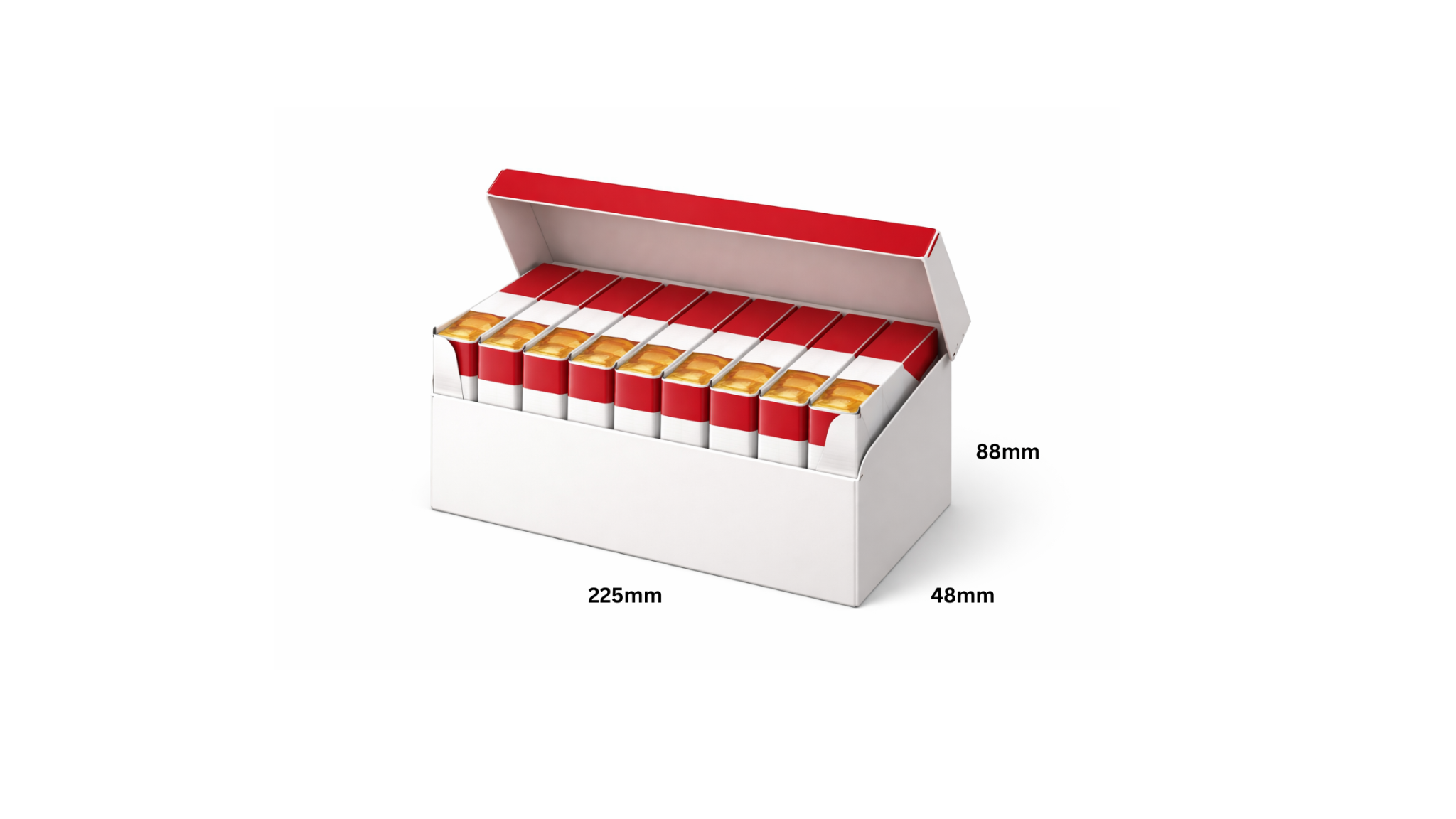
Industry averages have carton sizes being 225mm x 88mm x 48mm. These dimensions almost perfectly accommodate 10 standard packs arranged in rows of five. Packs that contain 25 cigarettes are usually a bit taller, leading to fewer packs in a carton (but you get more cigarettes per pack).
| Item | Approx. Size (mm) |
|---|---|
| Cigarette | ~84 mm long × ~8 mm diameter |
| 20-pack | ~85 × 55 × 22 |
| 200-cigarette carton | ~225 × 88 × 48 |
| 200-cigarette carton (25s) | ~225 × 88 × 52 |
Most Common Carton Sizes in Canada
1. The Classic Canadian Carton: 200 Cigarettes
This is the most widely recognized carton format. A carton consists of:
- 10 packs
- 20 cigarettes per pack
- Total: 200 cigarettes
This format is often what people mean when they say “a carton” in Canada and is commonly referenced in travel and customs guidance.
2. Cartons of 25s: 200 Cigarettes
Some Canadian brands and retailers sell cigarettes in packs of 25, which does not affect the number of cigarettes per carton, merely the number of packs that are in a carton.
- 8 packs
- 25 cigarettes per pack
- Total: 200 cigarettes
This format is especially common among certain Canadian brands and value-focused product lines.
3. Bulk Cartons (Less Common)
In some retail contexts (especially bulk or wholesale), you may see:
- 20 packs per carton
- Totals of 400–500 cigarettes
These are typically referred to as bulk cartons and are not the everyday consumer standard.
Why Canada Uses These Carton Sizes
1. Regulatory Consistency
Canada enforces strict packaging and labelling laws:
- Minimum pack size ensures room for health warnings
- Uniform packaging makes enforcement and taxation easier
- Prevents low-cost “entry packs” that could appeal to youth
2. Taxation and Excise Control
Cigarettes in Canada are heavily taxed. Cartons:
- Simplify excise stamp application
- Make enforcement easier at the retail and distribution level
- Allow authorities to track volume more efficiently
This is why government references often use 200 cigarettes (one carton) as a benchmark unit.
Carton sizes by country (and why they differ)
Canada
Canada’s laws set a baseline: cigarettes must be sold in packages containing at least 20 cigarettes. From there, what’s “typical” depends on what pack sizes are common in the market. The standard pack is 20 king-size, and there are also regular packs of 25s.
United States
The U.S. market is strongly centred around 20-cigarette packs, and cartons are commonly 10 packs (200 cigarettes).
United Kingdom
In the UK, packs are standardized to at least 20 cigarettes, and modern retail norms generally revolve around 20s—making 200-cigarette cartons common.
Australia (and some other markets)
Australia is an example of a market where pack counts can be more varied (you’ll commonly hear about 25s, but other counts exist), influenced by regulation and market practices. Plain packaging rules also shape how products are presented and standardized.
Why Cartons Exist at All
Cartons weren’t created just for convenience; they serve several practical purposes in Canada’s tobacco supply chain.
Retail Benefits
- Faster inventory management
- Easier restocking
- Simplified pricing for bulk buyers
Consumer Benefits
- Lower cost per pack
- Fewer trips to the store
- Consistent freshness when properly stored
Logistics & Shipping
- Cartons protect individual packs from damage
- They stack efficiently in warehouses and transport
- They act as the bridge between individual packs and wholesale cases
A Brief History of Cigarette Cartons in Canada
Cartons became standard as cigarette consumption rose throughout the 20th century. As smoking became more widespread, retailers needed a bulk format that was:
- Easy to store
- Easy to count
- Easy to sell
Over time, cartons became the default bulk unit, while governments began tying taxation, regulation, and reporting to standardized carton volumes, especially once health warnings and excise stamps became mandatory.
When Canada later introduced tighter packaging rules, carton structure stayed the same, even as branding changed.
Common Canadian Carton Configurations (Quick Reference)
| Pack Size | Packs per Carton | Total Cigarettes |
| 20s | 10 packs | 200 cigarettes |
| 25s | 8 packs | 200 cigarettes |
| 20s (bulk) | 20 packs | 400 cigarettes |
| 25s (bulk) | 16 packs | 400 cigarettes |
How Much are Cartons in Canada? (By Province)
Buying a carton can be a great way to save money rather than buying individual packs. Exact carton prices vary greatly from province to province. This is because each province sets their own provincial taxes on cartons. Below is a chart showing the average price of a carton across all ten provinces and territories:
Provincial Carton Price Overview (Estimated)
| Province | Avg. Carton Price (200 cigarettes) | Price Ranking |
| Quebec | ~$90–$110 | Lowest – most affordable province due to lower provincial taxes. |
| Alberta | ~$100–$120 | Low–Moderate – moderate taxation and no provincial sales tax. |
| Ontario | ~$110–$140 | Moderate – higher retail markup and taxes than QC/AB. |
| British Columbia | ~$120–$150+ | Higher – stronger provincial tax increases. |
| Manitoba | ~$130–$150+ | High – historically one of Canada’s most taxed provinces. |
| Atlantic Provinces (NS, NB, PEI, NL) | ~$130–$160+ | Among the highest in Canada due to strong provincial levies. |
| Nunavut / Territories | ~$150–$180+ | Highest overall — remote logistics + taxes drive prices up. |
FAQs: Cigarette Cartons in Canada
How many packs are in a carton in Canada?
Most cartons contain 10 packs, though some cartons may contain 8 packs.
Is a carton always 200 cigarettes in Canada?
Yes, 200 is the most common number of cigarettes per carton.
Are cartons regulated differently from packs?
Cartons themselves are not tightly regulated, but every pack inside them must comply with Canadian tobacco laws, including labelling and minimum size. Carton is the standard metric when determining allowance at duty-free or international airports.
Why does the government often refer to 200 cigarettes as a carton?
Because 10 packs of 20 is the most common and historically standard format used for taxation, customs, and reporting.
How much is an average carton in Canada?
The final price of a carton in Canada depends on the province you’re in and the retail location you’re buying from. Every province has their own tax and duty scheme, which makes prices vary greatly across provinces. Provinces like BC, Manitoba, Atlantic Provinces, and Nunavut have some of the highest taxes, therefore, prices on cartons. You can find the lowest carton prices in Quebec and Alberta. Carton prices will differ slightly among retail suppliers, depending on the markups they apply.
Final Takeaway
There are several advantages to having a standard number of cigarettes per carton; in Canada, this number is 200 cigarettes. Having this metric makes it easier for governments to tax tobacco products while bringing down the cost per pack for smokers. On the supply level, cartons make sense due to their structure, allowing for ease of storage and transportation. It also makes pricing more consistent across different retail locations. The biggest factor that has an impact on carton prices is provincial taxes, hence, the varying averages across different provincial lines. As a smoker, it’s important to understand why cartons are packaged the way they are and how it may impact your spending and consumption.
Want to save money on cartons? Shop online exclusively from Cigarette Express, and save up to 75% on bestselling native and Canadian cigarette cartons.